

The actual kit that went around the world in the World in Six Strings footage. Sixteen months, twelve locations, about $900 all in.

Guitar Tricks boasts its merit as the original guitar lesson platform launched in 1998 before any YouTuber taught free lessons. Almost 25 years later, online guitar lessons have become the standard way of learning, and as such new platforms arise every year.
Out of the big names, the best latest addition is Fender Play. Is the affordable Fender-led website a match for the massive Guitar Tricks library?
This Guitar Tricks vs Fender Play comparison finds me, as a teacher and session musician, in an advantageous position to guide you toward which suits you best. Beyond video quality, marketing, and famous teachers, you need to have teaching experience to compare two lessons, let alone entire learning methods, objectively.
Guitar Tricks and Fender Play are very similar in how they guide players in a step-by-step approach toward learning the instrument in their early days and continuously update the lesson and song libraries.
Fender Play goes the extra mile to make the journey easier to avoid all confusion for almost half the price for just started. In contrast, Guitar Tricks' more expensive but far broader range of lessons for all levels makes it the perfect companion for intermediate and advanced players.
Fender Play is the complete app for learning to play acoustic and electric guitar, bass and ukulele. Get started with step-by-step lessons. Use the code “learntoplay50” to get 50% off the annual plan.
Fender Play Online Guitar Lessons Learn How to Play Guitar
 We earn a commission if you make a purchase, at no additional cost to you.
The main differences between Guitar Tricks vs Fender Play are:

Guitar Tricks has taught over 4 million guitar students since its inception in 1998. Learning online was still new in every aspect, and all the possible credit goes to them as the industry pioneers.
Guitar Tricks offers a great blend of a user-friendly website with more than enough lessons of every possible genre, and style, making them one of the few award-winning guitar lesson websites.
What I love about the website and the company is that they never stopped innovating and did fall into the trap of getting stuck into old tech habits. Instead, their website has evolved over the years, with the newest update focusing on the modern concept of "learning paths."
The website always focuses on Step by Step methods of teaching guitar and tries to make the experience as fun as possible, opting for a similar game-like approach to Fender Play.
The core learning system takes beginners first through two guitar fundamental programs with all the basics and then branches out to 4 different styles; blues, country, rock, and acoustic.
The teachers are all professionals, not necessarily big names like TrueFire's masterclass hosts, but well-focused on specific genres to teach advanced players in-depth new concepts.
The only lessons that potentially reached more people than Guitar Tricks are famous Youtube channels familiar to all modern guitarists. Justin Sandercoe, Marty Schwartz, Rick Beato, Tim Pierce, and others might accumulate views, yet their free content is only part of the picture.
All have paid subscriptions that don't come close in the number of students to Guitar Tricks.
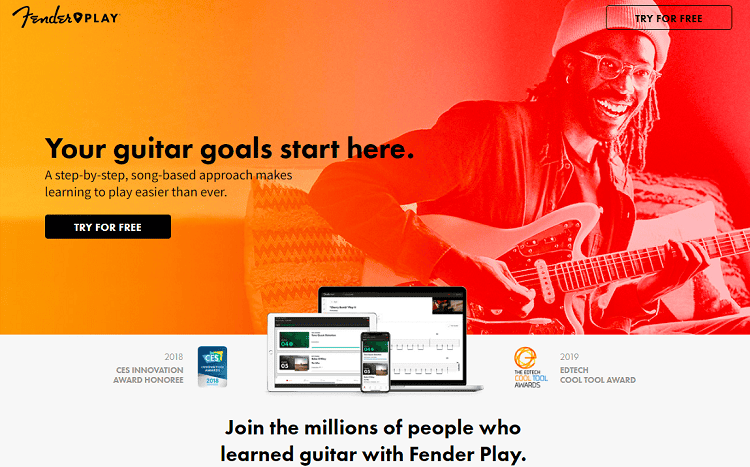
With slightly more than two years after its release, Fender Play is now an established platform for beginners that started the new trend of short, concise, well-structured video lessons. Fender prepared for years and invested much in sculpting modern internet scroller-like - simple!
Suppose you only started playing and, like many, figured out that too many YouTube lessons can get confusing. In that case, Fender Play is the ideal platform to demystify learning guitar and turn it into a simple game-like process.
Fender Play's main advantage over virtually every other platform is the friendly short-format videos that work perfectly for beginners. On your first month or even years of playing, teachers should avoid all the fluff to ensure you learn things properly and are not tired to go to the next lesson on the method.
In my early YouTube days, I would skip most of the content to where the action was. Even today, no matter how good the teacher is, parts of the lesson only take up the precious short attention span of modern-day
Fender Play assures quality by standardizing every lesson's formula, whether guitar, bass, or ukulele, regardless of the teacher and the instrument.
As soon as you choose your learning path, the website guides you toward the next best lessons and songs. Just as in video games, you get to 'level up from level 1 to 7 and then spin off on different techniques if you look for anything specific.
Practice mode is handy for going through new songs with the interactive tabs system, and the feedback mode of the app is getting better and better. Fender Play caught my attention for some time, and I even prepared a list of the best songs you can learn there.
A turn-off is that once you get to Intermediate or Advanced levels, there's only a little Fender Play can offer, apart from some songs or live streams with teachers where you can ask specific questions.
Also, as you advance and follow other teachers, you will notice that on Fender Play, some teachers lose their individuality and don't often share their experiences or show their style. I often bought TrueFire masterclasses or subscribers in blues guitar courses from master session musicians like Jack Person only for the teacher.
The lack of student/teacher connection has also to do with the lack of extensive style-specific content beyond a certain level and the fact that most of the songs are focused on mainstream music. Fender Play's learning paths often randomly change teachers, not helping build a connection to the teacher.
Fender Play is in no way though a "corporate guitar lessons" style learning platform. The giant guitar brand instead gives away perks such as discounts on gear, free subscriptions with purchasing affordable Fender instruments, and, yes, even a few free guitars!
Standardization for beginners is the best way to assure results, and the value for your money is unbeatable with all the options and perks.
Fender Play is the complete app for learning to play acoustic and electric guitar, bass and ukulele. Get started with step-by-step lessons. Use the code “learntoplay50” to get 50% off the annual plan.
Fender Play Online Guitar Lessons Learn How to Play Guitar
We earn a commission if you make a purchase, at no additional cost to you.

Picking the best lessons for beginners is like picking the ideal entry-level guitar. What works for an experienced player might not be as relevant and not worth the price for someone who has yet to get the best sound from a guitar. Tonewoods and vintage pickups are less critical than a guitar which makes practicing easy.
The same logic goes for guitar lessons for beginners. Whichever can make the learning process easier, is more accessible, and avoids confusion is the best. Fender Play successfully ticks all those boxes and is the best option for beginners compared to the much more extensive, yet at times overwhelming, Guitar Tricks.
Fender Play is better, even taking the price into account. After all, your first guitar should be cheap enough so you can upgrade in the near future.
Both are great, yet Fender's Learning Paths cut unnecessary minutes and are more satisfying to complete.
Both sides have exceptional instructors, with some session musicians working with world-renowned artists. More than the teachers themselves, I suggest using Guitar Tricks if you want to draw from the experience of the teachers due to the longer video format and the more 'freedom' teachers get.
Neither Fender Play nor Guitar Tricks could be the best option for you. I picked out three of the most interesting online resources I recently used, making sure there's something for everyone.

Lick Library was and still I the best in the world for learning songs note per note. You will find even the trickiest songs, genres, and mind-blowing guitar techniques on either old-school DVDs or streaming.
The teacher is second to none and head-to-head with TrueFire's arsenal of big shots. I always insist on saying that if a song lesson is not found anywhere or the piece is too hard to master, someone taught it on Licklibrary.

The all-around
No one is better, apart from probably Justin Gutiar, to making
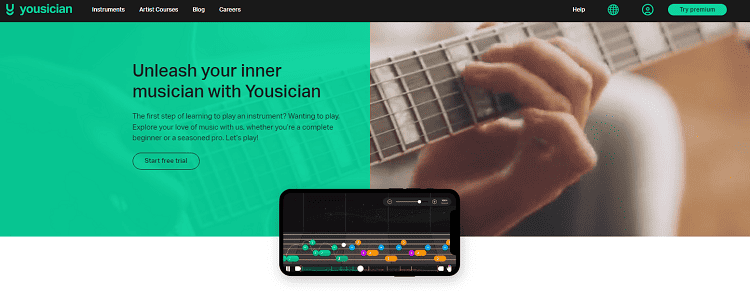
Guitar apps are not a standalone solution, yet they are the best modern companion to practicing songs. Out of all, Yousician is the most valuable and helpful when it comes to teaching guitar.
It blends in some video lessons and has a fun-to-play interactive interface that could keep a
Answer: No, Fender Play does not offer a refund after you purchase a subscription. You can, however, try the platform for seven days for free.
Answer: There are specific lessons on music theory, chords, scales, and all the main theoretical concepts. It offers more than Fender Play, but neither offers an ear training module to consolidate the knowledge.
Answer: Rick Beato's guitar lesson and ear training are the best online alternatives to learning music theory for guitar in a practical way.
Ultimately all learning paths or game-like level-ups are flawed, as they measure progress based on watched videos. Even the best interactive apps are not precise enough to correctly give feedback on your playing. So what's left to do to get the best out of online guitar lessons?
Whichever you choose of the platforms, the final result will depend on how you blend in a practice routine with the lessons. If any of the two platforms managed to keep you playing more, there is no need to consider other alternatives that look more flashy or have more lessons.
My advice to be sure you're continuously improving is to record yourself often to track your progress or, ideally, have occasional in-person lessons along with the monthly platform subscription.
Fender Play is the complete app for learning to play acoustic and electric guitar, bass and ukulele. Get started with step-by-step lessons. Use the code “learntoplay50” to get 50% off the annual plan.
Fender Play Online Guitar Lessons Learn How to Play Guitar
We earn a commission if you make a purchase, at no additional cost to you.

The actual kit that went around the world in the World in Six Strings footage. Sixteen months, twelve locations, about $900 all in.
Ever hit a G chord that feels bright and settled, then swap to G7, and suddenly it sounds a little…expectant? Like it’s leaning forward, waiting for the next page to turn. That “unsettled” sound is the whole point. G7 is a dominant seventh chord built from G (Root), B (Major 3rd), D (Perfect 5th), and […]
The first time I met B7, my hand froze. Four fingers, tight spacing, and one tiny mistake makes half the chord go dull. That is why I call B7 the Gateway Chord. It pushes your fingers to work as a team. You will hear it in Blues, Folk, Classic Rock, Jazz, and even acoustic metal […]