

The actual kit that went around the world in the World in Six Strings footage. Sixteen months, twelve locations, about $900 all in.

The first time I met B7, my hand froze. Four fingers, tight spacing, and one tiny mistake makes half the chord go dull. That is why I call B7 the Gateway Chord. It pushes your fingers to work as a team.
You will hear it in Blues, Folk, Classic Rock, Jazz, and even acoustic metal vibes from bands like Metallica, plus classic songwriting from The Eagles. By the end, you will know the notes, nail the open shape, grab a few cheats, and crush the E to B7 change.
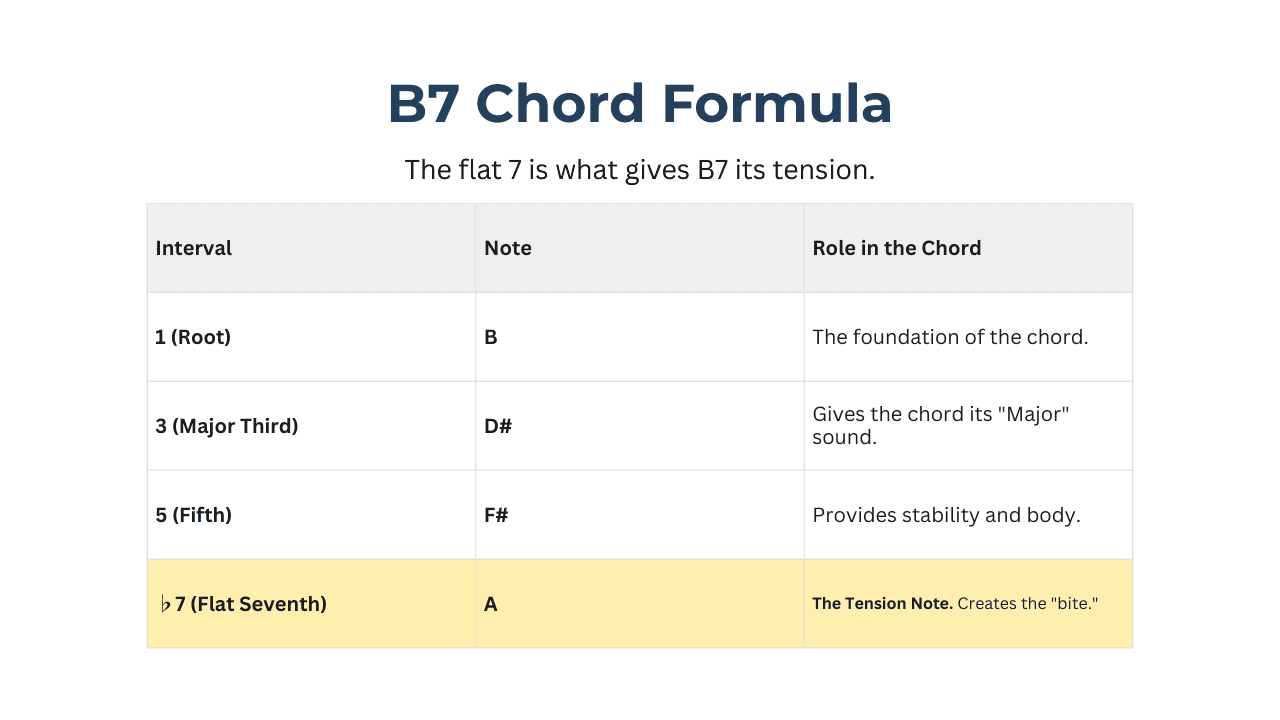
B7 is a four-note chord that carries tension on purpose. That little bite is what makes it feel like it wants to move somewhere instead of sitting still.
The notes inside B7 are:
Dominant 7 chords follow a simple formula you can reuse in any key. The pattern is:
For B7, that formula turns into real notes. You get B as the root, D# as the major third, F# as the fifth, and A as the flat 7. That last note (A) is the one that creates the tension people notice right away.
In the key of E, B7 acts as the V chord (the five chord). It naturally wants to resolve back to E major, which is why an E to B7 to E change sounds so “right” when you play it.
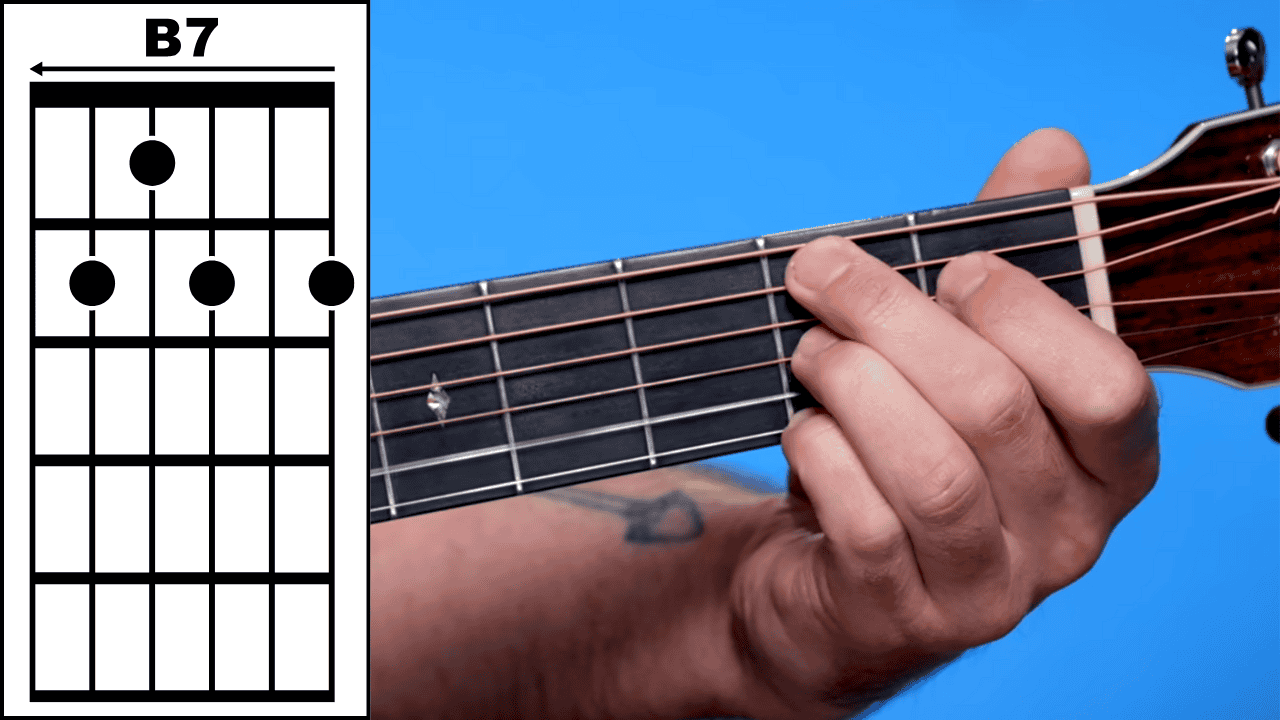
This is the open B7 most players learn first, and yeah, it can feel cramped. Once your fingers learn the layout, though, it becomes one of those shapes you can grab fast without thinking too hard.
Set your hand slowly and build the chord from the bottom up. Press close to the frets, keep your fingertips curved, and do not strum until your fingers feel planted.
Before you strum, look down at your fretting hand for one second. Your middle, index, and ring fingers should form a tight triangle, almost like they are huddling together.
When that triangle stays compact, your fingertips usually land cleaner and you stop bumping the open B string by accident. If the triangle spreads out, the chord often starts to sound messy.
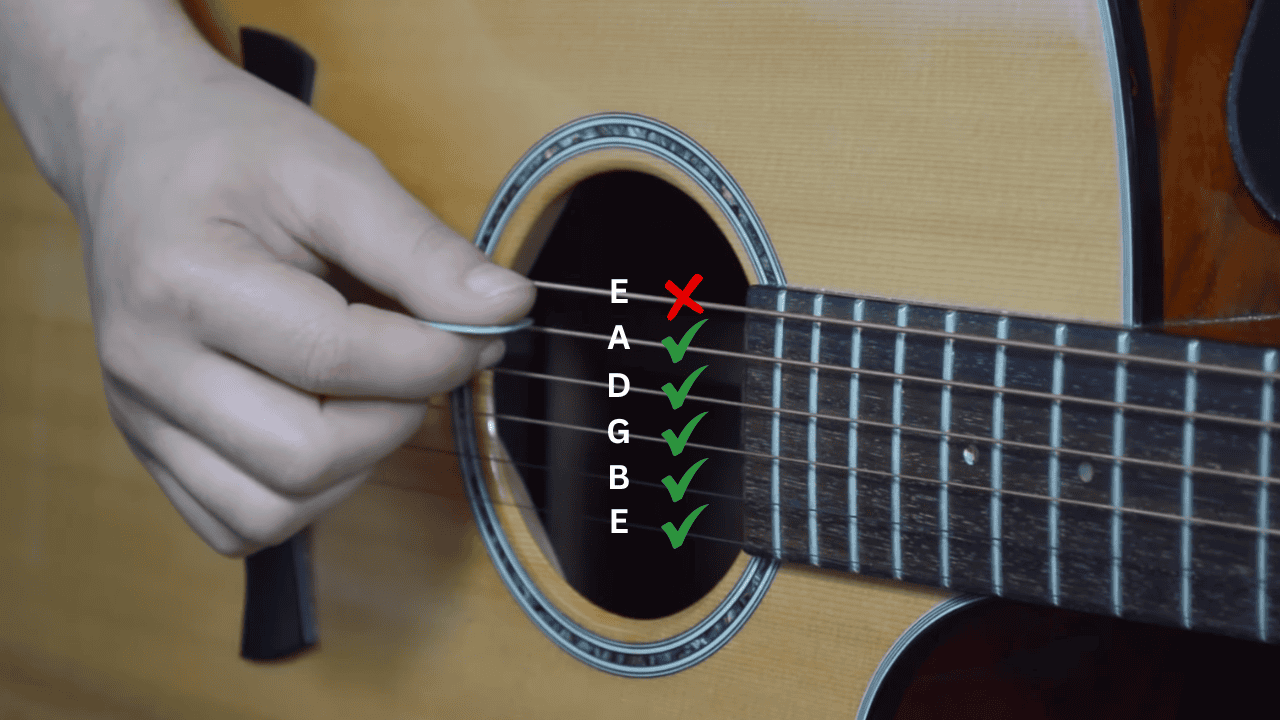
B7 does not need the low E string, so your strum should start from the A string and move downward. Think “A to high E” and you will avoid most of the muddy sound beginners run into.
If your strumming hand sometimes hits the low E anyway, do not stress. That is what the next trick is for.
You can mute the low E string without adding extra effort. Let the tip of your middle finger lightly touch the low E string while it frets the A string on the 2nd fret.
You are not pressing the low E down, you are just grazing it so it cannot ring. Then, even if your pick clips the low E, you get a soft thunk instead of a wrong bass note.
B7 usually sounds bad for the same few reasons, and that is good news. Fix the hand position once, and the chord cleans up fast.

Most B7 problems start behind the neck, not on the strings. Your thumb controls how much room your fingers have to curl.
Your fingers need a claw-like shape so they do not collapse onto nearby strings. The main danger is the open B string because it sits right under the fingers and gets muted easily.
Aim for fingertips, not finger pads. If a note goes dull, it is usually because one finger flattened out just a little.
This is the fastest way to find what is wrong without guessing. Strum the chord once, then pick each string one at a time and listen closely.
If the full open B7 keeps tripping you up, use a simpler version and keep playing the song. You can come back to the full shape later when your fingers feel less cramped.
This one keeps the main B7 feel, but it takes away the finger pile up. It is perfect when you want steady strumming and you do not want to stop mid-measure.
This version uses the standard open B7 shape but skips the pinky. It feels easier right away, and it can sound a bit brighter since the high E string rings open. Standard shape but without the pinky.
Once you move past the open B7, barre versions give you a thicker, more controlled sound. They also help when a song sits higher up the neck, or when you want the chord to punch through with less of that open string sparkle.
This shape sits low on the neck and feels chunky and tight, which is great for rock rhythm parts. Start by barring the 2nd fret with your index finger, keeping steady pressure across the strings.
After the barre is solid, add the rest of the shape. Put your ring finger on the 4th fret of the D string, then place your pinky on the 4th fret of the B string. Strum with confidence, but listen for any buzzing since that usually means the barre needs a small adjustment.
This one sits higher up and feels like an E7 shape moved up the fretboard with a barre. Barre the 7th fret with your index finger, then build the rest of the chord on top of it.
Place your ring finger on the 9th fret of the A string, your middle finger on the 8th fret of the G string, and your pinky on the 9th fret of the B string. This shape can sound punchy and bright, and once your hand locks in, it becomes a really reliable go to B7 for bandstyle playing.
B7 feels hard until your hand repeats it enough times that it stops feeling like a puzzle. These drills build clean muscle memory and make the E to B7 switch feel smooth instead of stressful.
Start by forming the B7 chord as clean as you can, even if it takes a few seconds to set up. Once it is in place, squeeze the neck with your fretting hand for three seconds, then release the pressure without lifting your fingers off the strings.
That means your fingertips stay touching the strings, but the chord stops ringing. Repeat that pulse ten times. This chord-on, chord-off motion teaches your hand the shape faster than mindless strumming, and it also teaches control so you are not gripping too hard.
This drill makes the E to B7 change way easier because it gives your hand a “home finger” that does not move. The secret is your middle finger.
Keep your middle finger on the A string at the 2nd fret for both E major and B7. Use it as a pivot point and do not lift it when switching. Move the other fingers around it like they are folding into place. At first, you will feel clumsy, then suddenly, it clicks and your hand starts landing in the right spot more often.
This one turns practice into a quick game, and it shows you progress fast. Set a timer for one minute and switch between E and B7, focusing on clean sounds, not speed at any cost.
Count how many clean E to B7 changes you can do in sixty seconds. Aim for thirty. If you hit ten today, that is fine, just write it down and beat it next time. Consistency wins here, not perfection.
Here are a few well-known songs where B7 shows up in a real, practical way. If you learn the chord inside one of these progressions, it sticks faster than drilling it in silence.
B7 might feel awkward at first, but it trains real finger independence and opens up a huge stack of songs across rock, blues, folk, and more. If you want it to stick, do the Pulse Method for five minutes right now before you close this page.
Set the chord, squeeze for three seconds, relax without lifting, and repeat. That small routine builds the shape faster than random strumming, and your next E to B7 change will feel way less stressful.

The actual kit that went around the world in the World in Six Strings footage. Sixteen months, twelve locations, about $900 all in.
Ever hit a G chord that feels bright and settled, then swap to G7, and suddenly it sounds a little…expectant? Like it’s leaning forward, waiting for the next page to turn. That “unsettled” sound is the whole point. G7 is a dominant seventh chord built from G (Root), B (Major 3rd), D (Perfect 5th), and […]
The first time I met B7, my hand froze. Four fingers, tight spacing, and one tiny mistake makes half the chord go dull. That is why I call B7 the Gateway Chord. It pushes your fingers to work as a team. You will hear it in Blues, Folk, Classic Rock, Jazz, and even acoustic metal […]