

The actual kit that went around the world in the World in Six Strings footage. Sixteen months, twelve locations, about $900 all in.

If you’re looking for a way to store and display your guitar, you’ve probably considered hanging it on the wall. Wall mounting your instrument saves space, protects it from damage, encourages you to play it more often, and just straight up looks cool.
There are different types of wall mounts to choose from, such as hook hangers, hangers with a yoke, multi-guitar hangers, and more! If you’ve got a guitar, and some basic DIY skills, it’s easy to hang your guitar on the wall. I’ll cover everything you need to know, including:

The first step in hanging your guitar on the wall is choosing the right mount. Everyone has personal preferences when it comes to storing their instrument, and there are also several other factors you should consider before purchasing a new mount.
There are many different styles of mount to choose from, so there’s something for everyone! However, if you're just getting started, it helps to familiarize yourself with the three main types of guitar wall mounts.
Hook hangers are the most basic and common style of guitar wall mount. They feature a simple, minimalist design with a two-pronged hook that rests around the neck of your guitar so it hangs from the headstock.
These hangers are aesthetically pleasing and affordable, but they do have a potential risk for the guitar to get knocked out of the stand if they get bumped (I’ve been guilty of it in the past).
If you’re looking for a little more stability, you could opt for a hanger with a yoke instead. These hangers have the same basic hook, but also have a long yoke that supports the neck of your guitar.
It’s also possible to get a classic guitar stand that mounts to your wall. I prefer wall-mounted stands for my more expensive and heavy display guitars, as this style of hanger is the most stable and protective.
However, they are a little bulky and take up wall space, as well as being a bit of a pain to use if you’re getting your guitar up and down all the time.
As you make your decision, make sure to consider all the factors that influence your choice of hanger style:
Once you’ve decided which stand to get, it’s time to make sure you have everything else you need. Making a list ahead of time and seeing what you already have will save you an extra trip to the store or paying double shipping fees from an online store. Here’s what you’re likely to need to wall mount your guitar:
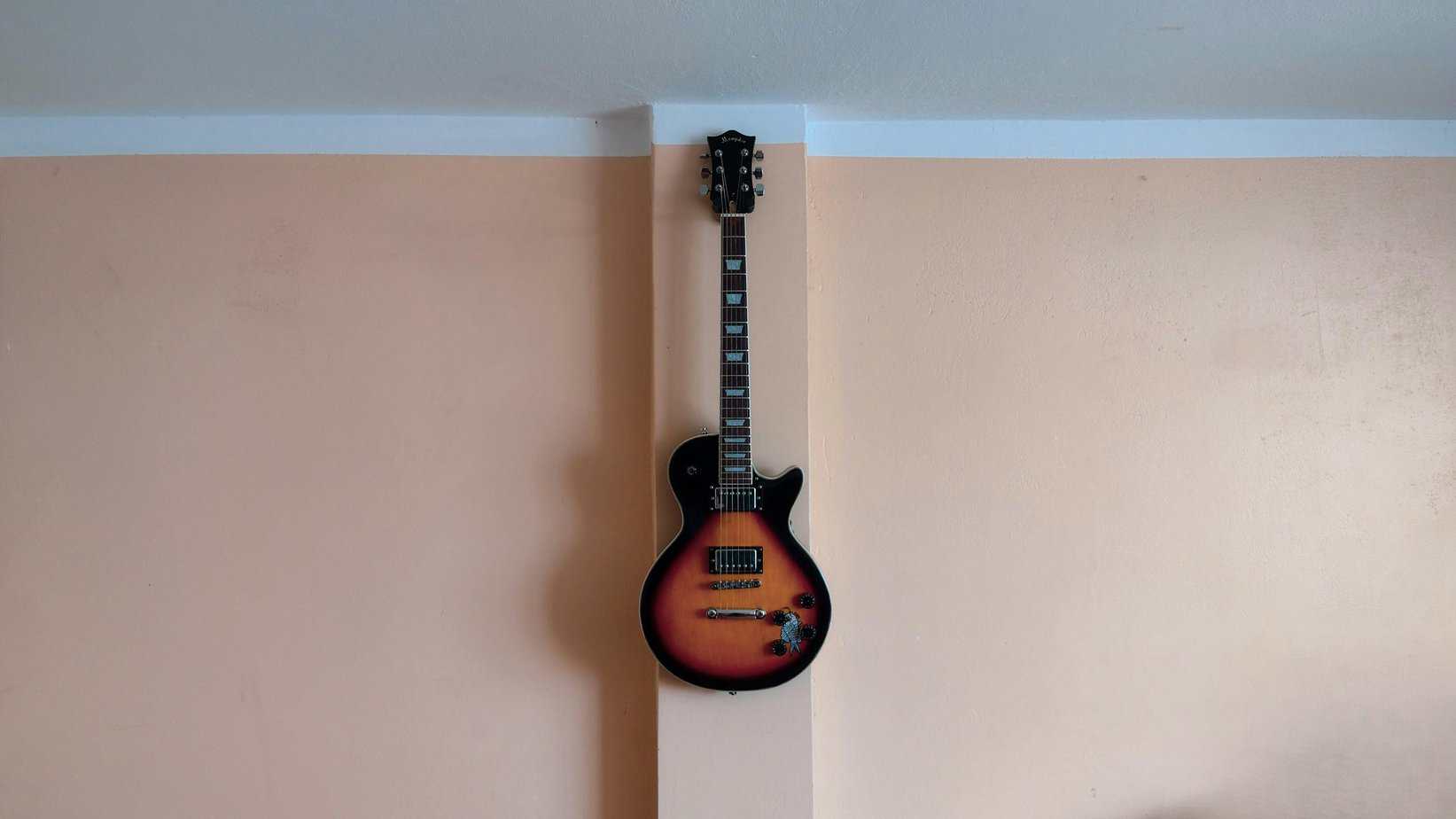
Once you’ve chosen your wall mount and gathered your materials, you’re ready to go! Here’s an easy step by step guide to hang your guitar.
Find somewhere that looks great in the room you want your guitar in. I generally go for some place where the guitar’s easily accessible and visible (and looks cool), but where the risk of bumping into it accidentally is low. You’ll want to avoid any direct sunlight, heat sources, and hanging it where it could fall on someone.
If you have drywall, use a stud finder to locate the best place to mount your guitar. If you’re not mounting into studs, make sure to use the appropriate wall anchors. For heavier guitars, like basses, you may want to consider using toggle bolts.
Using a level to ensure that your mount is straight, hold it up to the wall and use a pencil to mark out the screw holes. Double-check with a measuring tape and adjust as needed.
Drill pilot holes and insert the wall anchors if needed. Then, using a screwdriver or drill, secure the mount to the wall.
Carefully put your guitar on the mount and make sure it holds well and is stable. Don’t be tempted to “test out” the mount by hanging on it or yanking hard on it - it will break or damage the wall. Make any adjustments that are necessary, and then you’re done!
Hanging Multiple Guitars
If you’re lucky enough to have multiple guitars, you can put them on your wall as well! The process is generally the same, but you have a couple of options.
Using multiple single mounts allows you to control exactly where you display each guitar, and can look stunning! However, it does take up a lot of wall space - there should be at least twelve to sixteen inches in between guitars.
Using multiple single mounts allows you to control exactly where you display each guitar, and can look stunning! However, it does take up a lot of wall space - there should be at least twelve to sixteen inches in between guitars.
https://www.pinterest.com/pin/955677983428312913/
There are also purpose-built wall mounts for multiple guitars. These help with space saving and give a more cohesive look.
https://www.pinterest.com/pin/2674081020435154/
If traditional wall mounts aren’t for you, there are other ways to store and display your guitar! Some popular alternatives include:
Guitar stands are a classic and they’re not going away anytime soon. They’re cheap, portable, and don’t require any drilling or installation, making them optimal if you’re renting. Plus, there are many different types of guitar stands:
While it’s not as common, you can also mount your guitars from the ceiling! Ceiling mounts are a unique and attractive space saving solution, but make sure you follow best practices around safety and installation.
You can also DIY your own hanger with materials you have around the house! Some nice string or rope and a nail will do in a pinch - but be careful not to put too much stress on your tuners. You can also make a simple guitar stand with this template if you’re handy and have some plywood lying around.
Like any home improvement project, you need to keep safety in mind while wall mounting your guitar. This includes all the basics like tool safety, hazards, and wearing proper protective equipment, but there are also a couple of additional considerations:
If you’ve got little ones around, it’s important to make sure they won’t knock your guitar down and hurt themselves (or damage the instrument.) Some easy precautions include mounting your guitar higher on the wall, or using a locking wall mount. It’s also a good idea in general to teach your child about safely using the guitar.
If you live somewhere earthquake prone, it’s important to take some extra steps to secure your guitar wall mount. If your wall is drywall, definitely ensure you’re mounting into studs, and add additional wall anchors. You can also use specialized earthquake safety straps for additional security.
Generally, it’s recommended to store your guitar in a case to protect it properly. However, you can still keep your instrument in top quality while mounting it on the wall if you take some protective steps.
You should also work to maintain your guitar and mount to keep them both in top condition. Generally, this is through regular checks and cleaning.
If you’re looking for a storage solution for your guitar that’s space saving and displays your instrument, wall hanging is a great idea! It’s easy to install yourself, and there are different mounts for whatever you need. You should try it out and enjoy!

The actual kit that went around the world in the World in Six Strings footage. Sixteen months, twelve locations, about $900 all in.
Ever hit a G chord that feels bright and settled, then swap to G7, and suddenly it sounds a little…expectant? Like it’s leaning forward, waiting for the next page to turn. That “unsettled” sound is the whole point. G7 is a dominant seventh chord built from G (Root), B (Major 3rd), D (Perfect 5th), and […]
The first time I met B7, my hand froze. Four fingers, tight spacing, and one tiny mistake makes half the chord go dull. That is why I call B7 the Gateway Chord. It pushes your fingers to work as a team. You will hear it in Blues, Folk, Classic Rock, Jazz, and even acoustic metal […]