The actual kit that went around the world in the World in Six Strings footage. Sixteen months, twelve locations, about $900 all in.



Sound engineers in venues have it relatively easy with acoustic guitarists: they generally rock up with an electro-acoustic that can be just plugged in.
Granted, this can also be done in a studio setting, but studio engineers are going to want to make use of such a setting to get the nuances of an acoustic guitars properties. It generally offers a much fuller and warmer sound.
Here, we’ll take a look at the best microphones for recording acoustic guitars, across a range of budgets, to suit everybody from bedroom guitarists tinkering about on laptops, to the chief engineer at Abbey Road.

It’s going to be difficult to find an acoustic guitar mic that’s cheaper than this, that isn’t completely terrible.
This is a very tiny mic that you can clip onto the soundhole of an acoustic guitar or ukulele. It might be a useful piece of kit for sound engineers in venues to have on standby, should somebody rock up with a regular acoustic guitar.
IK Multimedia have very much been at the forefront of gear that’s firstly very small, and secondly, designed to work in tandem with mobile devices.
With the second aspect of their work on mind, the iRig acoustic is intended to be used with their Amplitube app, giving the user access to a host of amps and effects before the signal hits their audio interface.
It’s ideal for beginners messing around with the recording process, especially those who don’t have space for a more traditional mic and stand setup. It’s important to remember though, you’re going to get what you pay for.
It’s important to note that the Amplitube setup will only work for iPhone and iPad.

I think this offering from Audio-Technica is a very cool offering for home recording enthusiasts on a tight budget, or who want to get a bit of experience working with microphones before investing in a more “serious” piece of kit.
Like quite a few others on this list, this is a small diaphragm condenser microphone. Unlike the others though, this costs less than $100.

As I always say, you get what you pay for, so while this won’t be the same quality as some of the other mics on this list, it’s a step up from clip-on mics like the iRig Acoustic, because the user can get a feel for positioning the microphone around the acoustic guitar being used, and develop an understanding of how the different positioning of a mic like this can influence the recording.
For a $99 microphone, it’s a very sturdy piece of gear. It feels like you could throw it about a bit. Obviously, that’s not to say you should! It’s noted for its particularly bright output.
Alternatives
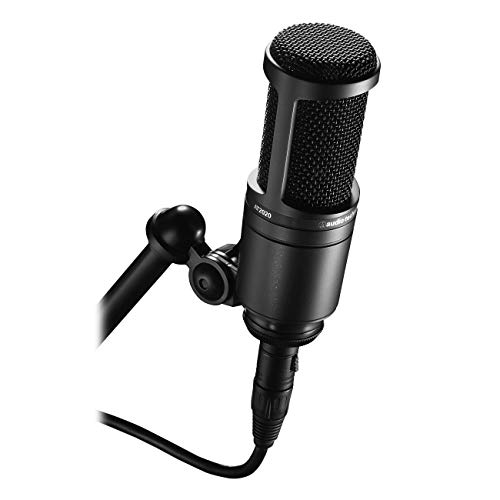

This reviewer’s most-used mic, but I’ll try not to be too biased! I first came across one of these working with a studio engineer who was using it for literally everything: acoustic guitar, electric guitar, vocals, percussion… whatever!
When I was writing more songs than I could afford in studio time and wanted to invest in some home recording gear, this was the microphone I went straight for.
This is the cardioid version. It comes in a solid metal casing and a dedicated shockmount for your mic stand. It has a frequency range of 20 Hz to 20 kHz, and a pre-attenuation of -10dB, and a whole bunch of other numbers that will only give away so much about the quality of
its sounds.
I’d recommend this for intermediate home recording enthusiasts who are prepared to spend a few dollars on a decent sound. Let’s not pretend your recordings with the 2200a II C are going to leave Rick Rubin worried about his job, but for listenable tracking at home, this is the only mic you’ll need.
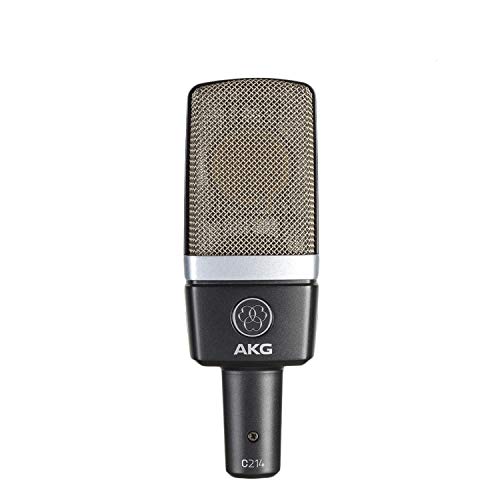
Like the Neumann mic that we’ll take a look at later, the C214 is best associated with vocal recordings, but man, it definitely holds its own for recording acoustics guitars too!
AKG actually tout this mic as an affordable version of their C414 model. That kind of aim is always tricky or brands to do - if they can make the same mic more affordable, why don’t they just make the affordable version?
The C214 is particularly respected for its ability to handle loud strumming, making it ideal for players like this reviewer. It also has noteworthy rugged construction, making it ideal for the mobile engineer, or for hobbyists who might want to bring it to the practice room.
In terms of actual practical performance, the C214 is generally regarded as provided much more bang for your buck than a mic at this price really should. That makes it well worth a look.

Probably one of the most mainstream brands of microphones in the world, Shure haven’t sustained their business since 1925 by making garbage.
Their SM range is one of their most popular, due to the affordability, and the variation of mics in it, and it has built up a solid reputation for being very reliable mics. All of these aspects point towards it being an ideal mic for those just getting started in home recording, as well as one for professionals to have on standby.
The mic is lighter than ones like it, making it good if you bring your recording rig to the musicians. It's designed to handle a range of sounds, particularly loud ones: ideal if you’re recording an acoustic style more akin to Frank Turner than Damien Rice!
Its smaller diameter will, of course, limit it a little bit in picking out an acoustic guitar’s lower range of tones. But it still retains the warmth of the sound. It makes it good in the right scenario.


OK, this is one of the coolest microphones I’ve ever come across. It’s a mic with a laser on it! A laser!
Readers of a certain age have just made quotation marks in the air with their finger while saying “la-ser.”
Aston Microphones have been on the go for only a few years, but everything they come out with has been phenomenally well-received.
The laser on the Starlight won’t blow up the planet, but it will help in positioning the microphone in the studio. You can mark where it was pointing when you position it where it achieves the sound you want. Mega.
Like a couple of the microphones here, the Starlight comes with a few switches to increase its versatility, and essentially cramming as much as possible into what they can offer you in a single mic, at this price. The main one is for voicing, with setting labeled as Vintage, Modern, and Hybrid, depending on what you’re recording.
All in all, a very tidy mic. I don’t think the laser is too gimmicky either, but I would advise considering your actual practical and realistic needs.
There are no other microphones with lasers, but you can probably find lasers for a couple of dollars that you can duct tape to one of these.

Don’t be alarmed by the price tag - it won’t take much research to find these much cheaper online. And the price quoted here is for a bundle with some other stuff - it seems impossible to just buy the mic by itself.

Like the AKG C214, the NT2A from Rode is particularly renowned for the quality it offers at its price point. If you’re reading a listicle on a review website as part of your research, that’s probably the kind of thing you want to hear. You’re welcome.
I mentioned that this is a bundle with a bunch of stuff. More specifically, the stuff is:
That’s right. A DVD.
The big and cool thing about the NT2A is the amount of variety in sounds that the user has. So many choices!
That’s fantastic. But it does lead to it being quite a weighty mic. I’d love to investigate whether all these options make it a jack-of-all-trades and a master of none, but alas, that won’t be today.


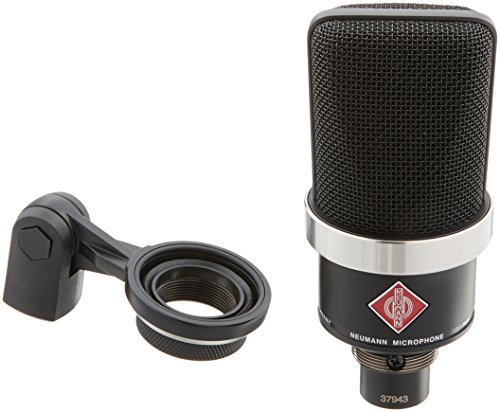
If you’ve ever done any kind of research into microphones before, you’ll be familiar with the Neumann name. You’ll also be aware of how pricey they can be - their best-known model, the U87, retails at the other side of $3k.
In recent years, they made some effort to produce microphones that will be a bit more accessible. Production is retained in Germany, rather than the east, like most companies do when they aim for affordable models, which is why the TLM102 still retails at considerably more than other well-known mic brands.
This is a large diaphragm condenser mic. There’s no doubt that this is primarily aimed at vocals, either speaking or singing, but it can definitely pull its weight for acoustic guitars too. Personally, if I was spending $700 on a microphone, I’d like it to be pretty versatile!
This is a smaller scale mic than most Neumann offerings - perhaps this is where the savings come from? It has transformerless circuitry, and it claims a slight presence boost above 6kHz.

Moving away from the condenser mic for a minute, here we have a ribbon mic. We’re also moving into higher end territory in terms of pricing. Royer tout the 121 as their flagship model. Between that and the price, you should expect a fair amount of awesome to be delivered.
If you’re still reading, this mic is probably best recommended for professionals and advanced intermediate home recording enthusiasts.
Once you pass the $1k mark, you’re going to want a versatile mic, and that’s something the 121 has nailed and is very much one of the things it receives most praise for. The other thing it’s most lauded for is its solid construction, which, when you spend that amount of money on a microphone, is definitely something I like to see.
This mic comes with a figure-8 pattern and is intended to deliver a warmth in recordings that will also capture the ambiance and unique sonic qualities of the instrument being recorded. That sounds cool.
Interestingly, this is the only ribbon mic that seems to be recommended for acoustic guitars, meaning it doesn’t really have any direct alternatives - everything goes back to condenser mics.

There’s a good chance you’ve never heard of Telefunken. That’s because of the price, they’re only used by the very top engineers who are making megabucks from their work. It’s certainly not a brand that would be familiar to home recording hobbyists. They’re almost as much of an investment piece as they are a studio tool!
Anyway, the C12 was actually originally made by AKG, but Telefunken has been making them for some time now. Those original AKG C12s change hands for around $20,000, making this contemporary working of it look pretty affordable!
There are a couple of things setting this mic above others on this list, name that it comes with its own power supply and a tube-driven mic cable. Those are kind of the essentials you need to make it work, but the kit also includes a shock mount, a wooden case, and a flight case that will hold the lot.
A cool feature of the C12 that greatly contributes to its versatility, is that you can decide whether it will operate as an Omni-directional, cardioid or figure-8 mic from the power supply.
This is the first time I can’t suggest an alternative. The bottom line is that if you can afford to spend this amount of money on this microphone, you have peaked. There are no other routes for you to go at this price point.
| Model | IK Multimedia iRig Acoustic | Audio-Technica AT2020 | sE Electronics 2200a II C | AKG C214 | Shure SM81 |
| MSRP | $49.99 | $99 | $349 | $399 | $436 |
| Mic type | Plectrum-shaped clip on | Fixed-charge back plate, permanently polarized condenser | Hand-crafted true condenser | Large diaphragm condenser | Small diaphragm condenser |
| Directional pattern | Omni-directional | Cardioid | Cardioid | Cardioid | Cardioid |
| Frequency range | 15 Hz - 10 kHz | 20 Hz – 20 kHz | 20 Hz – 20 kHz | 20 Hz – 20 kHz | 20 Hz – 20 kHz |
| Signal to noise ratio | 63 dBA | 74 dB, 1 kHz at 1 Pa | 80 dBA | 81 dBA | 78dB |
| Model | Aston Microphones Starlight | Rode NT2A | Neumann TLM102 | Royer Labs R-121 | Telefunken C12 |
| MSRP | $449 | $699 | $700 | $1,395 | $8,495 |
| Mic type | Small diaphragm condenser | Large capsule condenser | Large diaphragm condenser | Ribbon | Condenser |
| Directional pattern | Cardioid | Omni-directional, cardioid or figure-8 | Cardioid | Figure-8 | Omni-directional, cardioid or figure-8 |
| Frequency range | 20 Hz – 20 kHz | 20 Hz – 20 kHz | 20 Hz – 20 kHz | 30 Hz - 15 kHz | 20 Hz – 20 kHz |
| Signal to noise ratio | 79 dB | 87 dB | 73 dB | n/a | 16dB |

So there we pretty much have it. A round-up of some of the best microphones on the market for recording acoustic guitars, across a range of price points.
I could only list ten here, but remember that there are literally hundreds of microphones on the market. Some may not even be promoted as being good for recording acoustic guitars, but that doesn’t mean to say you won’t like it! Also, don't forget to wait for Prime Day which is when you can find some great guitar deals that really pay off.
Which leads to another very important point: the concept of a great acoustic guitar sound is entirely subjective. Here, I can only give my opinions. It’s so important for you to get to your local guitar store, talk to the staff, try out some microphones, see what gently caresses
your eardrums.
These days, most guitar stores have a department and person for recording. Make use of that!

The actual kit that went around the world in the World in Six Strings footage. Sixteen months, twelve locations, about $900 all in.
Ever hit a G chord that feels bright and settled, then swap to G7, and suddenly it sounds a little…expectant? Like it’s leaning forward, waiting for the next page to turn. That “unsettled” sound is the whole point. G7 is a dominant seventh chord built from G (Root), B (Major 3rd), D (Perfect 5th), and […]
The first time I met B7, my hand froze. Four fingers, tight spacing, and one tiny mistake makes half the chord go dull. That is why I call B7 the Gateway Chord. It pushes your fingers to work as a team. You will hear it in Blues, Folk, Classic Rock, Jazz, and even acoustic metal […]