The actual kit that went around the world in the World in Six Strings footage. Sixteen months, twelve locations, about $900 all in.



Even though many guitars are in great condition right out of the box, those who like to explore and experiment are always looking out for something they can improve on their instruments.
Some of the most obvious upgrades are things that are most visible when we pick up a guitar: the pickups, the tuners, the nut, the input jack, the bridge, the tremolo system, among other parts.
However, what about the guitar's potentiometers? These components, often called "pots" exist on our guitars to control volume and tone parameters. Some guitars have two of each, and some have only one, but their usefulness is undeniable regardless of which guitar we're discussing.
In this Guitar Potentiometer Upgrade Guide, you will learn everything there is to know about these guitar parts that are often overlooked, but that can bring a lot of character to your sound if you make the most out of them.

Upgrading your guitar's potentiometers may be a great idea, especially if your guitar seems to have low-quality hardware.
Since these are much cheaper to upgrade than other components like the guitar's pickups, you can experiment with more options and ultimately find out what works best for your preferences.
Potentiometers have different resistance values, which makes them affect your guitar's tone in different ways. As a rule of thumb, 500k pots go with humbuckers, 250k pots go with single coils, and other less-used pots like 25k go with active pickups.
At the end of the day, there is no rule that everyone must follow, and you can pair whichever pots with any pickups. Sometimes, a less traditional choice might yield surprising results that you didn't expect to enjoy, which is why you should explore and experiment as much as you can.
Potentiometers, or "pots" for short, are used to control volume and tone on guitars and other amplified instruments like the bass.
They are essentially variable resistors that are there to adjust the electrical resistance in the signal path, thus changing the tone that you hear through your amplifier.
My favorite analogy to explain how a potentiometer works involves comparing it to a light bulb with adjustable brightness. If you have a desk lamp with a slider that increases and decreases the intensity of the light by sending more electrical current to the bulb, you are seeing the same thing that happens with the potentiometers.
As you increase the volume knob from 0, the signal becomes louder, and if you do the same with a tone knob from 0, it will get progressively brighter.
While upgrading these components will not yield as much difference as upgrading the pickups, it is still worth considering since it is not as expensive, and the subtle difference it makes might inspire you to play differently.
Also, some of the cheaper guitars usually have low-quality potentiometers that brands install to save money, making them one of the most logical upgrades that you can make. If you know how to solder and enjoy DIY projects, it could even become a fun activity for you to do in your free time.
There are a few "sub-families" of potentiometers that you should know and investigate a bit before deciding which ones you're going to buy, as they will affect the guitar's tone and the pot's behavior when going from 0 to 100 in their rotation.
Lastly, if you are thinking of replacing your pots because they seem noisy and you hear a scratching sound while rotating them, you should consider cleaning them first, as dust buildup is known to cause this problem.
Hollow and semi-hollow guitars are especially prone to this since the electronics are more exposed to dust than in solid-body guitars with an internal cavity designed to accommodate them.
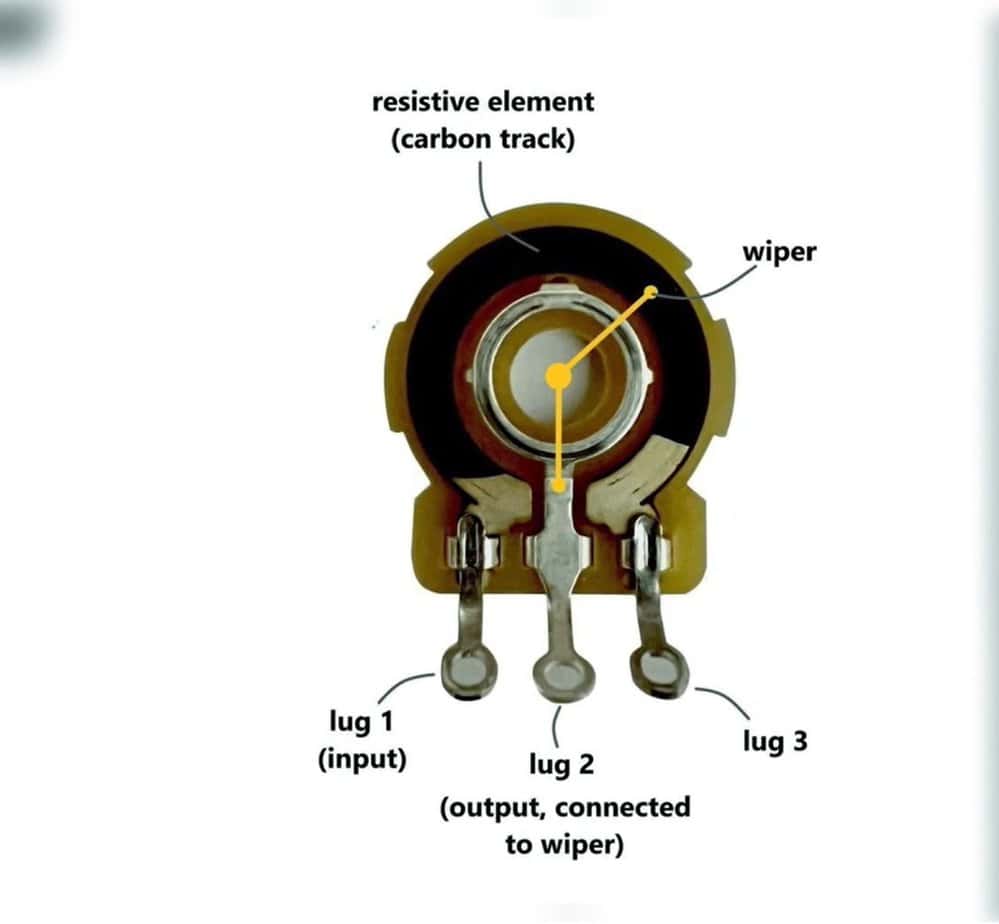
Even though you can use whichever potentiometers you'd like on your guitars, there are a few things to take into account if you want to know how manufacturers choose which pots they install on their guitars.
It mostly has to do with the pickups on the guitar, but it isn't mandatory to follow these rules. Ultimately, you should experiment as much as you can and try to figure out what works for you.
You might want a tone that is brighter than most people's, or maybe you want to go as dark as possible, and the appropriate potentiometer choice can nudge you in the right direction.
Manufacturers tend to follow these pairing rules for potentiometers and pickups:
Again, even though manufacturers usually follow this tendency, every potentiometer works with every pickup.
You can pair a humbucker with a 250k to make it sound brighter than usual, or use a 500k pot with a single-coil pickup to highlight its brightness as much as possible.
Although most pots look the same at first sight, there are a few core differences that you can't neglect. Finding high-quality parts is half of the job done, but you should also try to find out what is most appropriate for your instrument, as well as what sounds best to your ears.
There are a few rules of thumb to take into account, but ultimately, the best potentiometer for your guitar is the one that sounds and feels best, so don't get too attached to these so-called "rules".

Volume and Tone potentiometers are very similar to each other. At first sight, you can only tell which ones are which by checking the label, if they have one, or by memorizing the usual places where they are located in popular guitar designs (the first knob on a Stratocaster usually controls the volume, and the other two control the tone, for example).
The difference between these two is very simple:
A capacitor (also referred to as "tone cap" or "cap") is used as a blocker that prevents low frequencies from reaching your amplifier. Adding this tiny component to a volume pot turns it into a simple EQ knob.
By varying the amount of resistance passing through the guitar's circuitry, you can adjust how much high-end frequencies are in your overall sound.
Shaft length is not something that affects the tonal properties of potentiometers, but you must know which ones your guitar needs, otherwise you might buy something that doesn't fit yours.
Guitars with a thicker top like Les Pauls need a long shaft pot to be mounted securely.
On the other hand, guitars with thin tops or that have their electronics mounted on the pickguard like Stratocasters require short shaft pots.

Making an educated and logical decision in regards to your potentiometers has to go through deciding whether you want audio taper pots or linear pots, as this will affect how they work and feel significantly.

While this is far from being the most important aspect to discuss about potentiometers, you still have to know whether you need split shaft or solid shaft pots.
Fortunately, there is not much to know about this and the difference does not affect the sound, only the installation.

I first discovered push/pull knobs and their usefulness when I bought a Dean Soltero guitar, at the age of 15. The salesman told me that by pulling on the tone knobs, I could go from a humbucker to single-coil in a split second. This is commonly referred to as "coil tapping" or "coil splitting".
The idea seemed amazing, and it truly is! Although I am still an advocate that if you want a single-coil sound, you should play a guitar that has that kind of pickup, it is still a great tool to have available, and even though I don't have that guitar anymore, I still enjoy push/pull knobs on other guitars.
Push/pull knobs aren't only for coil splitting, though. One of my favorite guitars, a Smitty Custom S Classic, inspired by the Fender Stratocaster, has a push/pull knob that reverses the phase of the middle pickup, allowing me to obtain awesome out-of-phase sounds that remind me of Albert King every time I use them.

The music industry of today has a lot of choices for everyone's tastes and budgets. Potentiometers are no exception, and in a time when people like to read and know more about what is in their guitars, brands have stepped up their game and they offer all kinds of options.
Here are a few brand suggestions that you might want to look up if you're thinking about getting some new potentiometers for your guitar. Some are dedicated to manufacturing guitar parts exclusively, and others are famous guitar brands that you already know and have decided to build this type of component as well.
Aside from the potentiometers and their caps, there are a few upgrades that your guitar might benefit from. A new set of quality pickups might be expensive, but before you pop yours out, you should consider upgrading a few other components. Here are a few of my top suggestions:

Upgrading the nut on your guitar may be a sensible decision. It isn't expensive, and the results can be significant.
For instance, my Gibson SG, which cost more than $1400 came with a nut that didn't have properly filed slots, the string height didn't appear optimal, and the strings would sometimes get stuck after bending them, leading to tuning issues.
I spent less than $20 on a new bone nut, and my guitar tech installed it for me. Overall, it cost less than $40 and it solved the tuning issues I was having right away.
The most popular nut materials are bone, plastic, graphite, metal, and TUSQ, a high-end plastic that mimics bone, thus eliminating the need to use the real thing.
My recommendations are generally bone and TUSQ, especially for guitars that have plastic nuts installed by the manufacturer.

Upgrading a guitar's bridge can improve the instrument's tuning stability, intonation, and sustain. All of these are critical aspects necessary to sound good, so it would be wise to make sure you don't have any problems.
Even though upgrading the tuners on some guitars might not make a world of difference, it can still solve some of the common causes of low tuning stability. A faulty gear that slips, a broken screw, and other inconveniences can be a real pain when you need your guitar to work flawlessly.
There are many kinds of tuners, such as locking tuners, vintage-style tuners, and sealed gear tuners. Before buying, you should make sure that what you're getting is compatible with the guitar you want to install them on.
The input jack is not a particularly important component in terms of getting a good tone, but a cheap quality one will suffer more from normal wear and tear. This will eventually lead to loose parts, unwanted noise, and other unwanted issues.
Since it is a cheap upgrade to apply, it is worth considering it for guitars you really care about and use regularly.

Modding guitars can be a fun way to obtain new sounds and access to techniques you wouldn't be able to use otherwise.
For example, my custom Stratocaster has a push/pull knob that reverses the phase of the middle pickup, allowing me to get out-of-phase sounds from it. I also had a treble bleed mod done, which is meant to prevent high-frequency loss as I roll back the guitar's volume knob.
Tom Morello is famous for modding his guitars with a killswitch, which is a button that mutes your signal when you press it. It is a quick way to achieve the same effect as you get when one of your pickups is set to max volume, the other with no volume, and you switch back and forth between both pickups quickly.
It is worth exploring the world of mods and seeing if there are any that you might benefit from having or might enjoy trying if you are into DIY projects that involve electronics.
Answer: Volume and tone potentiometers are the same, except for the fact that tone pots have a capacitor (also called "tone cap" or simply "cap") attached to them. This small change turns it into a kind of EQ knob that rolls off high frequencies as you go from fully open to closed. Different types of caps affect the potentiometers differently.
Answer: While the choice of potentiometers is entirely subjective and up to your personal preferences, manufacturers generally pair 500k pots with humbuckers, and 250k pots with single coils. Doing so helps brighten up humbuckers and tame shrill high-frequencies from single-coils.
Answer: Audio taper pots are generally used for controlling volume, and they increase at a higher rate after a certain point in their rotation, giving a more perceivable sensation of increasing or decreasing the volume. Linear pots, on the other hand, are generally used for tone controls, and they affect the signal linearly, as in a straight line.

Guitar potentiometers, or "pots" are used to control the volume and tone of the instrument, and there are various types that are meant to be used with different kinds of pickups and electronics.
Some pots make your pickups sound brighter, while others tend to cut off high frequencies, giving them a warmer and darker character. Even though brands generally advise you to pair them in a certain way, I encourage you to experiment as much as you can to figure out what works for you and your playing style.
Upgrading the pots on your guitar may also make them more durable and reliable for an inexpensive price, but if you're not comfortable with replacing them, you should ask a qualified technician to do it for you.
Continue reading:

The actual kit that went around the world in the World in Six Strings footage. Sixteen months, twelve locations, about $900 all in.
Ever hit a G chord that feels bright and settled, then swap to G7, and suddenly it sounds a little…expectant? Like it’s leaning forward, waiting for the next page to turn. That “unsettled” sound is the whole point. G7 is a dominant seventh chord built from G (Root), B (Major 3rd), D (Perfect 5th), and […]
The first time I met B7, my hand froze. Four fingers, tight spacing, and one tiny mistake makes half the chord go dull. That is why I call B7 the Gateway Chord. It pushes your fingers to work as a team. You will hear it in Blues, Folk, Classic Rock, Jazz, and even acoustic metal […]