The actual kit that went around the world in the World in Six Strings footage. Sixteen months, twelve locations, about $900 all in.



I love the smell of a new acoustic guitar. And, to be honest, it's really the smell of the wood. Yeah, there’s glue and metal there, too. But, it’s the woody scent of a new guitar that I love—I don’t know why.
I remember when I brought my first steel-string acoustic guitar. As soon as I got home, I put my nose to the sound hole and took in the scent of the instrument.
At the same time, I looked inside the guitar's body and saw an intricate structure of different pieces of wood, deliberately arranged in a design that piqued my curiosity. To my young imagination, this was the skeletal system of the guitar.

To discuss the bracing system of the acoustic guitar, we need to have a basic understanding of how the guitar works. Although this is an oversimplification of the process, it is necessary to explain the essential function of the bracing system.
Here are the basics of how sound is produced by a guitar:
Early guitars used gut strings that were eventually replaced by nylon. These guitar strings did not create enough tension to require a stiffer top. In the 20th century, steel guitar strings were introduced, and, as players required more volume from the instruments, new bracing systems were developed.

An acoustic guitar bracing system is an arrangement of wooden struts (called braces) that are added to the inside of the guitar's top and back. They are usually made from wood (in most cases, some variety of spruce) and arranged along the length of the guitar's body.
This system helps reduce the stress on the neck, bridge, and strings due to vibrational feedback. The bracing system has three primary functions:
Without the bracing system, the guitar could suffer from unwanted noises and ultimately be incapable of producing a pleasant sound. This article provides a comprehensive overview of acoustic guitar bracing systems and how they work.
Fun Fact: Guitars made from composite and carbon fiber materials do not require a bracing system. However, some companies are experimenting with bracing techniques to help shape the sound.

Soundboard bracing is also called top bracing and is responsible for the guitar's sound. In addition, the bracing design pattern has a noticeable effect on the sound quality produced by an acoustic guitar.
But, things get a little sticky here, and opinions vary. The acoustic principles involved are very complex. And, acoustic engineers and luthiers don't fully understand the functional relationship between the braces and how vibrations travel from the bridge to the soundhole.
Numerous studies using holographs, oscilloscopes, graphite dust, etc., have demonstrated the complexity of the vibration patterns of the guitar's soundboard. This has led to luthiers experimenting with everything from neck weights to tonewoods and from the wood used for the sides to variations in bracing patterns.
Traditional bracing systems are broken down into three main types:
Also, many manufacturers have experimented with proprietary bracing patterns. I'll discuss those briefly below.

The ladder bracing is referred to by two other names: straight bracing and transverse bracing. This system was invented by luthier George Fullerton in the early 1900s. The system consists of thin, parallel wooden struts glued to the guitar's inner sides. This design helps create a more stable guitar sound and withstands lower string tension, which is essential for classical and other delicate music styles.
The history of the ladder bracing system began with the Spanish guitar in the 1500s and evolved through various models of guitars throughout the centuries. Today, the transverse bracing system is still used on many acoustic guitars and is considered one of the key elements for producing an articulate sound.
This system was used in the early years of steel-string acoustic production. The braces were placed straight across (or slightly offset) and perpendicular to the soundboard grain.
The ladder bracing system contributes little to the strength and performance of the instrument. This bracing system was used until the 1960s, when Japanese X-braced guitars cornered the market. Today, some luthiers use the ladder bracing system to reinforce the back of the guitar.

The fan bracing system works well for nylon-string classical guitars and folk guitars. But, they can't handle the tension created by steel strings.
In the early 19th century, luthiers used three, four, or five struts in patterns similar to the modern fan bracing system. But in the middle of the 19th century, Spanish guitar maker, Antonio Torres, experimented with a design using seven struts and secondary braces. And versions of this system are still in use today.
The braces are aligned with the wood's grain (or direction). They are not perpendicular like the ladder system. The fan bracing system allows the guitar's larger body and thinner soundboard to produce the warm, organic sound with a solid bass response that classical guitars are known for.
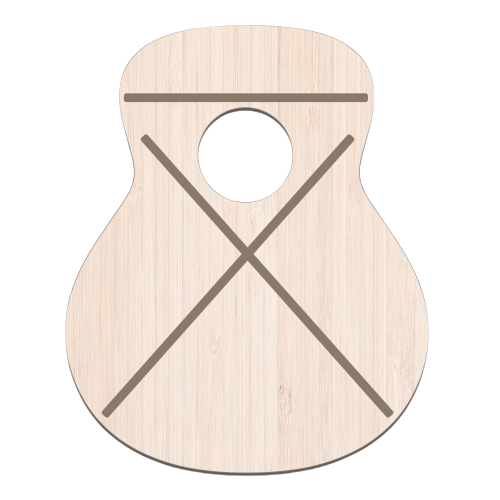
In the mid-1800s, C. F. Martin developed the X bracing system, and, by the close of the 19th century, Martin acoustic guitars exclusively used X braces in all of their guitar designs. (Please note that this is before the use of steel strings).
X Bracing (and its variations) forms the traditional bracing design for steel-string instruments. The system has two braces crossing each other and creating an "X" shape below the sound hole. In some configurations, the bracing uses several secondary, transverse, and flat struts.
The X brace formation uses two lower arms to support the bridge's two ends. A hardwood bridge plate is placed under the bridge to prevent the ball end of the steel strings from damaging the underside of the guitar's soundboard.
The special X Series GPCX Grand Performance Acoustic-Electric Guitar has a powerful, rich tone, with all the sustain you have come to expect from a Martin guitar.
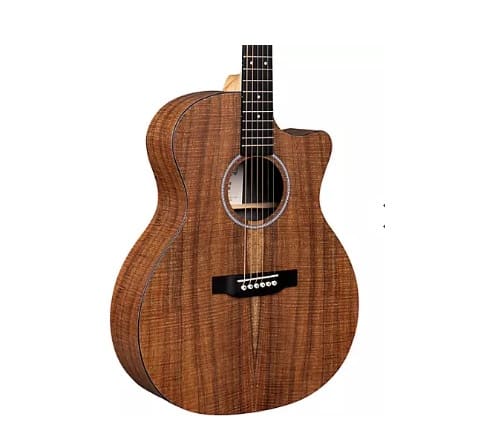 Martin Guitar X Series GPC-X2E Acoustic-Electric Guitar | Amazon
Buy at Amazon
Buy at Guitar Center
We may receive compensation from the companies whose products we review. We only recommend products that we believe in and test.
Martin Guitar X Series GPC-X2E Acoustic-Electric Guitar | Amazon
Buy at Amazon
Buy at Guitar Center
We may receive compensation from the companies whose products we review. We only recommend products that we believe in and test.

Scalloped braces are chiseled in the middle of each brace in a symmetrically curved pattern. This reduces the weight of each brace and makes them more flexible.
The pros are that the added flexibility allows the top to vibrate more freely (more volume). Also, the crossing point of the X design is set a little higher, which provided early Martin guitars with their identifiable sound.
The cons are that scalloping compromises the strength of the bracing. This can lead to arching or bellying of the tops between the bridge and the soundhole. This effect was more common when steel-string guitars were first introduced. Martin responded to the arching and bellying of tops by suspending scalloping the braces. Also, they moved the crossing point of the two braces closer to the bridge.
But, many players preferred the Martin sound delivered by scalloped braces. So, in the 1970s, these players began custom shaving the braces of their guitars. And, in the mid-1970s, Martin brought back scalloped X bracing and high brace positions on some of their select models.
Martin Guitars have three different placements of the X-bracing system that you should be aware of:
Many manufacturers offer these features in today's modern instruments. But, these enhancements only make a real difference on high-quality instruments. It is not very useful on mass-produced or pre-shaved instruments and may only be a marketing gimmick. Also, focusing on the bracing style is meaningless if the top is not finely-made.
Many studies show that long, thin braced patterns achieve the best overall sound. These designs provide the most significant structural strength while allowing the guitar's top to freely vibrate.
Many highly-skilled luthiers use the hand-shaving process to finely tune the braces to the soundboard.
Here's how it works:
This process improves the tuning, enhances responsiveness, and maintains the guitar's structural integrity.

The V-class bracing system was developed by master guitar designer Andy Powers from Taylor Guitars. Powers wanted to solve the trade-off of using the X Brace system.
The bracing system needs to balance two counteracting properties, the flexibility and stiffness of the top of the acoustic guitar. Or volume (flexibility) and sustain (stiffness).
The solution was the V-class bracing style, which resulted in louder and longer-sustaining notes. Andy Powers had successfully created the Advanced Performance Bracing used in the 800 Series of Taylors with a completely new bracing design.
V-class bracing makes the guitar tops stiff in the direction of the strings to produce notes that sustain longer. Also, guitars with V-class braces are more flexible on both sides of the top to create an orderly motion or, as Powers puts it, "There's no chaos and no fight between the notes that we play and the way that the guitar would respond."
This system resulted in better intonation, improved power, enhanced sustain, greater projection, and refined touch sensitivity.
Here's How It Works
This design provides strength and support to the center of the guitar and its bridge, improving sustain. And allows the sides the flexibility to vibrate freely.
If money isn't the parimary concern, the Big Baby Acoustic is an EXCELLENT value for a premium fingerstyle guitar (around $600). A great pick for beginners and experienced players alike.
Runner-Up
Taylor Big Baby Acoustic | Sweetwater
 We earn a commission if you make a purchase, at no additional cost to you.

Another Taylor innovation is their proprietary C-class bracing system. This system was developed by Taylor for smaller body shapes. The C class uses some of the concepts of V class braces to improve the sustain and volume at the same time.
These have an asymmetric, cantilevered arrangement that emphasizes the lower frequencies to produce a robust bass response from a much smaller-shape guitar.
Lattice bracing first appeared in the late 1970s and is still popular with many players today. The stiffness produced by this pattern allows for the use of much thinner wood in the soundboard. And still resists the tension of the strings. This also enables luthiers to reduce the guitar's total weight.
Besides the traditional patterns above, many other bracing patterns are also popular. Here are a few of them.
This is just as the name suggests. Two X braces overlap to form a diamond shape surrounding the bridge plate. This bracing design reinforces the top but restricts the vibration and is used mainly in twelve-string guitars.
Three main proprietary design styles are defined as the A bracing system:

Guitar backs are also braced to reinforce the structural strength and maintain the body's stiffness resulting in the body acting as a resonating chamber. The main decision while designing them is whether the back will take an active role in the sonic characteristics of the guitar.
Typically, these braces include a combination of high & thin studs and low & flat ones. Other designs, including X Bracing, have tried turning the backs into a second soundboard. While some manufacturers use the transverse system as a simple reinforcement solution.
Sides are made from bent wood and can be subjected to knocks, making them very vulnerable to lateral cracks. So, they are reinforced by using a cloth soaked in glue or pieces of wood like mahogany, cedar, or spruce. These reinforcements are placed strategically on the guitar sides where the stress points are expected to be most vulnerable to localize grain cracks and prevent the sides from splitting along the grain.
The inner workings of the guitar are vital to the instrument's tonal characteristics. The challenge of meeting the player's requirements while paying careful attention to the structural needs of the instrument has been a balancing act that has led to innovation.
From the simple ladder bracing system to the fan bracing of classical guitars, the guitar continues to evolve, and dedicated luthiers are committed to improving the acoustic guitar. Martin's X system became the standard for steel-string instruments until Taylor created innovations with their V and C class bracing systems.
But, what does the future hold? Classical guitar luthiers, like Kenny Hill, have made advances using lattice bracing sandwiched between two paper-thin guitar tops. Composite guitar makers are experimenting with different bracing designs as they improve the tonal capabilities of non-wood guitars.
It's an exciting time for acoustic guitars, and technological advances keep me looking forward to the future. Thanks for reading.

The actual kit that went around the world in the World in Six Strings footage. Sixteen months, twelve locations, about $900 all in.
Ever hit a G chord that feels bright and settled, then swap to G7, and suddenly it sounds a little…expectant? Like it’s leaning forward, waiting for the next page to turn. That “unsettled” sound is the whole point. G7 is a dominant seventh chord built from G (Root), B (Major 3rd), D (Perfect 5th), and […]
The first time I met B7, my hand froze. Four fingers, tight spacing, and one tiny mistake makes half the chord go dull. That is why I call B7 the Gateway Chord. It pushes your fingers to work as a team. You will hear it in Blues, Folk, Classic Rock, Jazz, and even acoustic metal […]