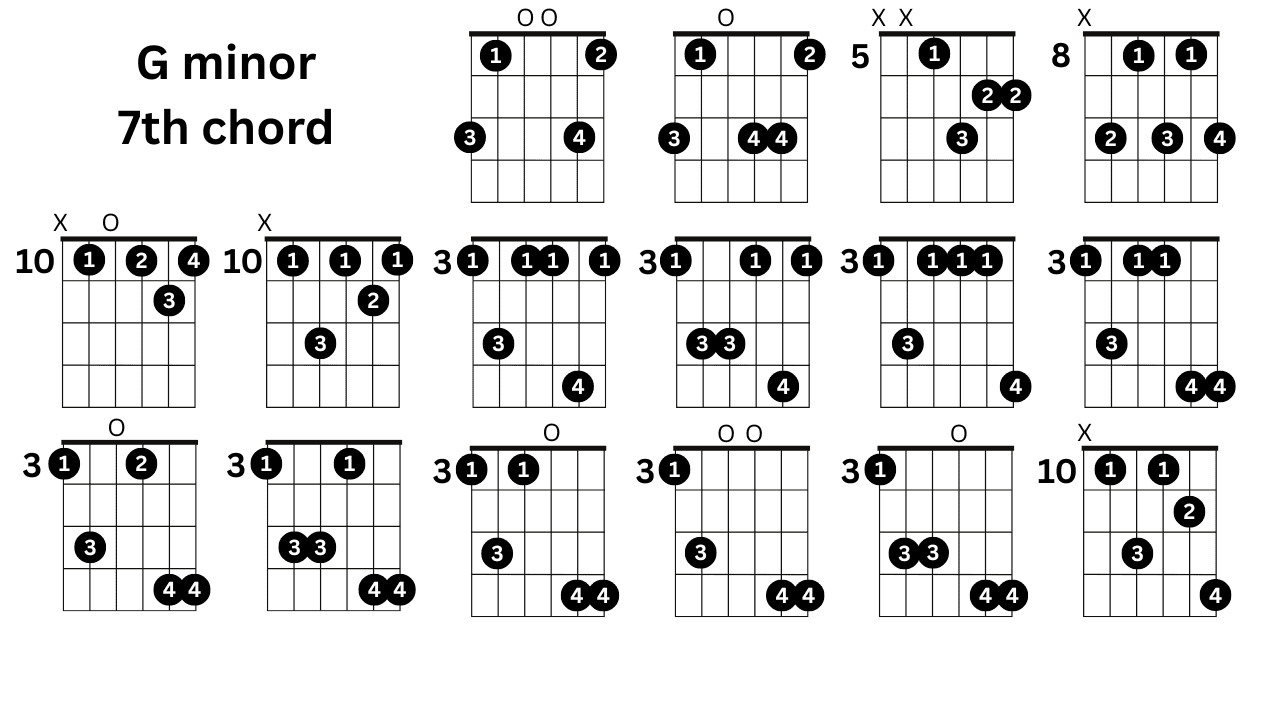
Looking for that smooth, soulful sound you hear in everything from funk to jazz? Meet the G minor 7th chord. In this guide, you’ll learn what Gm7 actually is, how it sounds, and four reliable ways to play it right now. Worried about barre chords? No stress…we’ll start with easier shapes that still deliver the vibe.
What is a Gm7 Chord?
Gm7 is a G minor chord with one extra note that softens the edge and adds color. Think of it as G minor, plus a gentle lift from the seventh.
Formula: Root, minor third (3), perfect fifth (5), flat seventh (b7)
Notes: G, Bb, D, F
Gm7 feels smooth and jazzy, a touch moody without getting heavy. Compared to plain G minor, the added F (the flat seventh) makes the chord feel wider and more soulful, giving your rhythm parts a relaxed, classy vibe.
How to Play the Gm7 Chord
The Gm7 chord can be played in a variety of shapes across the fretboard, each one offering a slightly different tone and feel. Below are four reliable ways to play it, starting from the classic barre chord and moving toward simpler and more colorful options.
Shape 1: The E-Shape Barre Chord
This is the most common way to play Gm7 and is rooted in the familiar “E minor” barre form. It’s strong, full, and works well in many styles.
Use your index finger to barre all six strings at the 3rd fret. Place your ring finger on the 5th fret of the A string and your pinky on the 5th fret of the D string.
Pro Tip
If you want a simpler variation that feels closer to a regular G minor barre chord, try 353333 by barring the 3rd fret and placing your ring finger on the 5th fret of the A string, leaving your pinky off.
Shape 2: The A-Shape Barre Chord
This voicing sits higher on the neck and delivers a brighter, tighter sound that shines in funk, soul, and R&B.
Chord Diagram
E A D G B e
x 10 12 10 11 10
Fingering
Barre the top five strings at the 10th fret with your index finger. Place your ring finger on the 12th fret of the D string and your middle finger on the 11th fret of the B string.
Pro Tip
Because it’s voiced higher, this chord slices through a band mix. Short, snappy strums here create that signature rhythmic pop.
Shape 3: The Easy 3-Note Shape
If you’re just getting started with seventh chords, this stripped-down version is perfect. It focuses on the core notes of Gm7 and skips the barre.
Chord Diagram
E A D G B e
x x 5 3 6 x
Fingering
Place your ring finger on the 5th fret of the D string (G), your index finger on the 3rd fret of the G string (Bb), and your pinky on the 6th fret of the B string (F). Keep the other strings muted.
Pro Tip
Even though this version leaves out the fifth, it still captures the essential sound of Gm7. It’s easy to play and works well in softer or busier arrangements.
Shape 4: The Jazzy Inversion
This one is compact, smooth, and often heard in jazz contexts. It has a slightly different flavor because it places D in the bass instead of G.
Chord Diagram
E A D G B e
x x 8 7 6 6
Fingering
Put your ring finger on the 8th fret of the D string (D), your middle finger on the 7th fret of the G string (F), and use your index finger to barre the B and high e strings at the 6th fret (Bb and D).
Pro Tip
This “rootless” voicing is called Gm7/D. It sits high up the neck and connects smoothly to other chords in jazz progressions, making it great for creating elegant transitions.
How to Practice the Gm7 Chord Effectively
Getting comfortable with Gm7 takes steady practice, but the good news is that you don’t need hours at a time.
Short, focused drills are enough to build strength, accuracy, and confidence with the chord. Below are four simple approaches that will make the shape feel natural under your fingers.
Muscle Memory Drills
Before worrying about strumming, train your hand to land the shape cleanly. Form a Gm7 chord, squeeze gently for a few seconds, then release and shake your hand out. Repeat this “claw” motion several times.
It builds finger strength while teaching your hand the correct spacing and pressure. Over time, your fingers will start to drop into place automatically.
The Gm to Gm7 Transition
One of the best practice tricks is moving back and forth between G minor (355333) and Gm7 (353333). All you do is lift your pinky to switch to Gm7, then place it back for G minor. This tiny movement trains precision and teaches your ear to hear the subtle shift in mood between the two chords.
Chord Change Practice
Once the shape feels comfortable, put it into progressions. Playing Gm7 in context makes it more musical and less like an exercise. Try these two common patterns:
Jazz Progression (ii–V–I in F): Gm7 → C7 → Fmaj7
Funk/R&B Groove (i–iv): Gm7 → Cm7
Loop them slowly, then increase speed once your fingers move cleanly between chords.
Start Simple
If barre chords feel heavy, don’t jump straight into them. Begin with the smaller voicings, like Shape 3 or Shape 4. They’re easier on the fingers but still give you the true Gm7 sound. Once you’ve nailed those, moving into the full barre versions will feel far less intimidating.
Songs That Use the Gm7 Chord
One of the easiest ways to hear and understand Gm7 is by spotting it in real songs. This chord shows up across jazz, soul, disco, and even rock, often giving a section a smoother or more colorful feel. Here are a few well-known tracks where Gm7 plays an important role:
“Just the Two of Us” Grover Washington Jr. (feat. Bill Withers): Built around a silky chord progression, this song opens with Gm7 and keeps that sound flowing throughout, setting the relaxed mood.
“I Will Survive” Gloria Gaynor: This disco classic uses a famous cycle of chords that, when shifted to certain keys, brings Gm7 into the mix. It adds depth and texture to the driving rhythm.
“Don’t Stop Me Now” Queen: In both the verses and the chorus, Gm7 helps give the harmony its distinct energy and flair, sitting perfectly alongside the piano-driven arrangement.
“Lovely Day” Bill Withers: Here, Gm7 helps shape the warm and soulful vibe of the progression, making this track one of the most recognizable feel-good songs of all time.
Conclusion
The Gm7 chord is built from the notes G, Bb, D, and F, and you now know four reliable shapes that cover everything from beginner-friendly grips to fuller barre voicings. Each shape brings its own flavor, whether you want smooth jazz tones or a bright funk rhythm.
With steady practice, the chord will start to feel natural and open doors to new sounds. Keep working it into your playing, and soon, it’ll flow without thought. What songs are you planning to bring Gm7 into? Share your favorites and inspire other players.
Author
Guitar Space Team
Johnson Sutherland is a working guitarist and contributor at GuitarSpace.org, where he’s helped build the site since 2022 with player-first reviews and practical guidance for everyday musicians.
Guitar Space
He has performed with multiple bands—Haymakers, Mean 44s, and Henhouse—and has contributed to releases available on Spotify and Apple Music. Rooted in blues, rockabilly, and rock, his writing bridges real-world gigging and recording experience with clear, actionable advice on gear, tone, and technique.
Ever hit a G chord that feels bright and settled, then swap to G7, and suddenly it sounds a little…expectant? Like it’s leaning forward, waiting for the next page to turn. That “unsettled” sound is the whole point. G7 is a dominant seventh chord built from G (Root), B (Major 3rd), D (Perfect 5th), and […]
The first time I met B7, my hand froze. Four fingers, tight spacing, and one tiny mistake makes half the chord go dull. That is why I call B7 the Gateway Chord. It pushes your fingers to work as a team. You will hear it in Blues, Folk, Classic Rock, Jazz, and even acoustic metal […]
Hitting that beginner plateau on guitar can feel rough; you sit down to play, pick a song you love, and realize it is way beyond your current skills. That kind of mismatch drains motivation fast. The smarter move is to start with songs that sound great but use simple building blocks like open chords, standard […]